Solar Wind Magnetosphere Ionosphere Link Explorer (SMILE)
The Solar Wind Magnetosphere Ionosphere Link Explorer (SMILE, also known as the “Smile” satellite), jointly developed by the Chinese Academy of Sciences (CAS) and the European Space Agency (ESA), is the concluding mission of Phase II of the CAS Strategic Priority Research Program on Space Science. It is another large-scale international collaborative space science mission led jointly by China and Europe following the Double Star Program in 2003, and a new milestone in comprehensive, mission-level in-depth cooperation between Chinese and European scientists. Using state-of-the-art imaging techniques, the satellite provides simultaneous observations of the magnetopause, the polar cusps and the auroral oval; combined with space-based and ground-based in-situ measurements of the solar wind and the magnetosphere, it delivers the first panoramic imaging observations of solar wind–magnetosphere interaction across the entire space weather chain. The mission brings a new observational perspective to space physics research and directly contributes to predicting and mitigating space weather hazards.
SMILE was successfully launched on 19 May 2026 from the Guiana Space Centre in Kourou, French Guiana. After about one month of orbit-raising manoeuvres, the satellite reached its science orbit on 20 June, with a perigee of 5,120 km and an apogee of 120,900 km. After arriving at the planned orbit, the payload module and the scientific instruments were switched on in sequence and operated normally; the instruments completed in-orbit commissioning and calibration, acquired valid scientific data, and performed as expected.
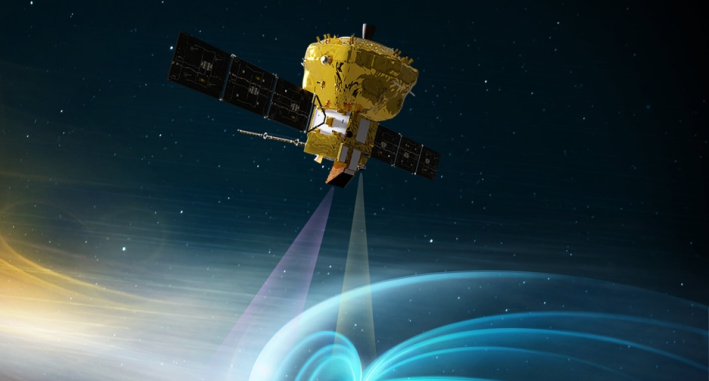
The key science objective of the SMILE mission is to investigate the dynamic response of Earth’s magnetosphere to the impact of the solar wind, through more than 40 hours of continuous X-ray imaging of the magnetosheath/polar cusp region and extreme ultraviolet imaging of the global auroral distribution, complemented by simultaneous in-situ measurements of plasma and magnetic fields in the solar wind and magnetosphere.
1) To probe the large-scale structure and fundamental modes of solar wind–magnetosphere interaction;
2) To understand the global evolution and cyclic variations of magnetospheric substorms;
SMILE carries a state-of-the-art suite of scientific instruments. The payload comprises: Soft X-ray Imager (SXI): images Earth’s magnetopause, polar cusps and magnetosheath; Ultraviolet Auroral Imager (UVI): images Earth’s auroral regions; Light Ion Analyser (LIA): performs real-time in-situ measurements of low-energy ions in the solar wind, the magnetosheath and the magnetosphere near Earth; Magnetometer (MAG): measures the three-dimensional vector of the magnetic field at the spacecraft, obtaining the magnitude and direction of the solar wind magnetic field.
Soft X-ray Imager (SXI):
SXI is a wide-field soft X-ray imager based on the lobster-eye imaging principle, consisting of an optical lens assembly and a large-format CCD detector array. It has a field of view of 27° × 16° and an energy band of 0.2 keV–5 keV, providing wide-field coverage and good energy spectral resolution.
The SXI optics are assembled from lobster-eye micropore optics (MPO) plates. The MPO micropores are square channels, and the plates are thermally slumped to the required radius of curvature. Each MPO plate measures 4 cm × 4 cm, with a thickness of 1.2 mm and a radius of curvature of 600 mm. The micropores are 40 µm wide, and their walls are coated with iridium to enhance soft X-ray reflectivity. The instrument is equipped with composite filters to suppress stray light.
The SXI focal plane is formed by two CCD detectors butted together. The CCDs adopt a back-illuminated design without an anti-reflection coating, which significantly improves quantum efficiency in the X-ray band, with an energy resolution of 50 eV (FWHM) at 0.5 keV. Soft X-rays emitted by the solar wind charge exchange (SWCX) process are concentrated mainly in the 0.2 keV–2.5 keV band, while photon signals at higher energies originate from cosmic rays.
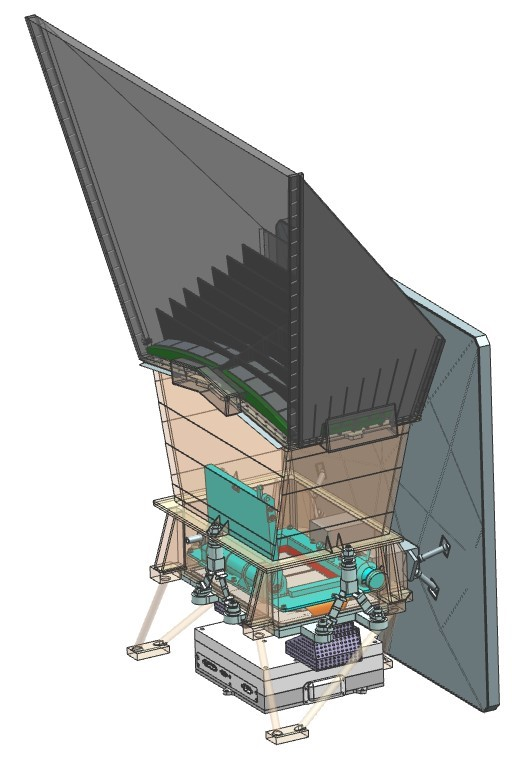 Figure 1: CAD model structure of the SXI
Ultraviolet Auroral Imager (UVI):
The Ultraviolet Auroral Imager is a telescope composed of four mirrors, using a CMOS detector to capture extreme ultraviolet emission images of the aurora over the 155 nm–175 nm wavelength range. The imager consists of three main parts: the imager camera (UVI-C), the imager electronics box (UVI-E) and the harness (UVI-H) connecting the camera and the electronics box. It employs a coaxial four-mirror optical design optimised for the orbit and the temporal and spatial resolution requirements of the SMILE mission. The combination of ultraviolet filter coating technology and the four-mirror design provides stronger visible-light rejection than previous auroral observation missions, ensuring that the science objectives of the imager are met. In addition, the detector is a microchannel plate (MCP)-based image-intensified CMOS detector, with the imaging phosphor screen optically coupled to the CMOS sensor.
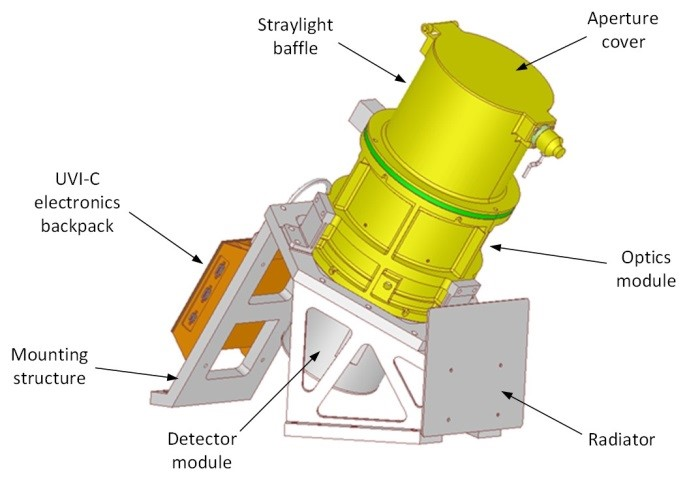 Figure 2: CAD model structure of the UVI (UVI-C)
Light Ion Analyser (LIA):
The Light Ion Analyser uses a top-hat hemispherical electrostatic analyser combined with deflection plates to measure ion velocity distribution functions in the 50 eV/q–20 keV/q range. High voltages applied to the deflection plates select incident ions over an elevation angle range of 0°–90°. Ions entering the electrostatic analyser are deflected by the electric field between the two hemispheres and strike an annular microchannel plate at the rear. The energy of ions able to pass through the analyser is determined by the voltage applied to it. Behind the annular microchannel plate are 48 detection anodes, each with a field of view of about 7.5°, giving a total azimuthal field of view of 360°.
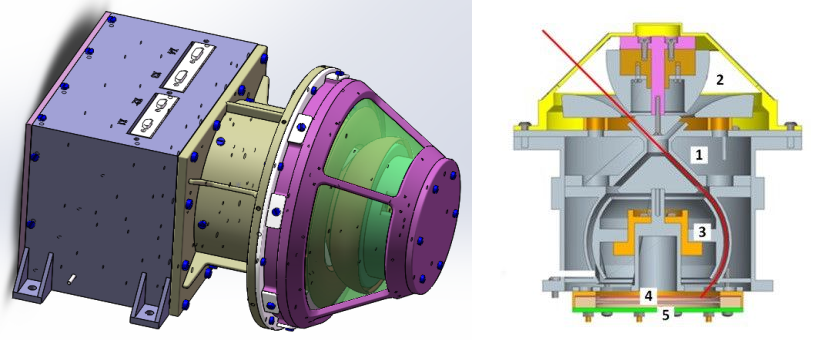 Figure 3: Three-dimensional rendering of the LIA instrument (left). Cross-section of the sensor head (right); the red lines show the trajectories of detected ions.
Digital Magnetometer (MAG):
The Digital Magnetometer (MAG) is a high-precision space vector magnetic field instrument that measures the three-dimensional vector of the magnetic field at the spacecraft, providing in-situ data on the magnitude and direction of the field. To ensure measurement accuracy, the magnetometer system is equipped with two sets of tri-axial fluxgate sensors and a 3 m hinged deployable boom to reduce the influence of spacecraft-generated magnetic interference on measurement precision. Sensor signals are transmitted by cable to an electronics box mounted on the payload module (PLM), where a field-programmable gate array (FPGA) performs digital signal processing to derive the magnetic field information. The two sensor sets are mounted at the end of the boom at distances of 2.3 m and 3.0 m from the spacecraft, enabling simultaneous tri-axial vector magnetic field measurements and providing magnetic field gradient information. This greatly reduces the interference of the spacecraft’s residual magnetic field with the ambient field being measured and improves the accuracy of vector magnetic field measurements.
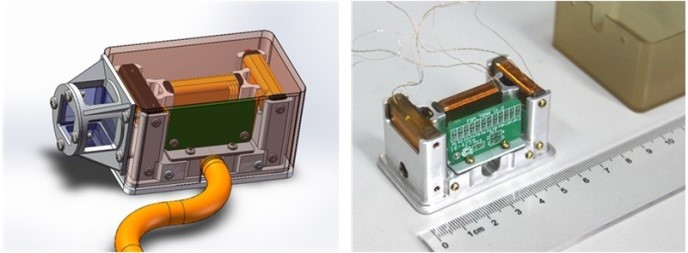 Figure 4: MAG sensor head. (Left) 3D rendering; (right) completed engineering model.
Search and download:https://smile.nssdc.ac.cn/